




French host families
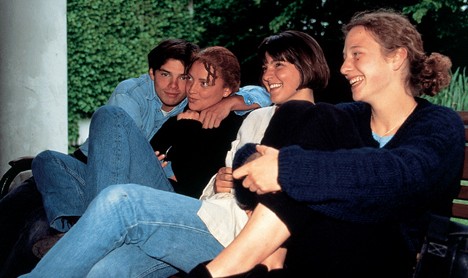
 A volunteer host family welcomes the exchange student. Most of the time, the host family lives in a rural or semi rural area, at the center or at the suburbs of a city. Host families are very different one from another; each one has its own habits and its own way of living. Participants must get used to their host family rhythm and rules: that is the challenge of this experience. An exchange student can be placed in a traditional, divorced or stepfamily, with a single person whether that person has children or not… There isn’t a typical family. Host families-parents and children-expect to build a strong and lasting relationship with their host. They want the student to be involved in all the aspects of the family life. The principal of receiving a foreign exchange student is based on a real cultural exchange in terms of activities, daily life, ideas…the goal is to have the student fit in the host family and become a part of the family.Host families will be enriched from talks and time spent with their host. Those moments will also help the foreign student to get a better understanding of France and the culture. Each and everyone one will learn a lot from such an experience but relationships built and solidified day after day will prevail for they are the true richness of this experience.
A few tips related to the life with a host family
1. Once the exchange student is placed, he/she will quickly get in touch with his host family. Host families appreciate having direct contact with the natural family of the young student they will host.
2. The host student must not spend too much time in his/her room; he/she will take the risk of missing out in his experience by isolating him/herself. It is important that the student learns to know his/her host family and vice versa.
3. Families feel they are responsible for the well being of the student they host and expect student to let them know about his/her schedule on a regular basis.
4. Parents appreciate that their children regularly clean their living space (bedroom and bathroom), it is a sign of respect and good manners; they expect the same from their host student, who is considered part of the family. An exchange student must make sure his room keeps a good appearance and not hesitate to offer a hand for the daily tasks.
Le lycée français
The host student attends a French high school.
French high school wants to give equal opportunities for students to succeed: that is one of the bases of our school system. The school is public, therefore free. Private schools usually cost money but most of them are on contract with the state and reasonable offer school fee unlike many countries.
Public schools are secular. They must not take sides concerning political or religious questions.
In France, we have a centralized school system. The Jacobin legacy is significant. In France, school days are regulated in a same way everywhere in the country. Students usually study between 20 and 30 hours a week (around 6 hours per day). They sometimes work on Saturdays. School programs are substantial. Students start studying early in the morning and finish at the end of the afternoon. However, schedules are more flexible than in middle school: they vary a lot depending on the grade and section. A class last from 50 to 55 minutes, but sometimes a student can have a 2 hours class. There is a break in the morning and another one during the afternoon, and an extended break for lunch: from 30 minutes to 2 hours depending on schedules. Most students eat at the cafeteria situated inside the school.
In France, teachers often give lectures and prefer this approach to group work. The relationship between teacher and student is very formal, and not personal. When talking to a teacher, student must use “vous” rather than “tu”, it is a sign of respect.
Education in high school last for 3 years: seconde (sophmore), première (junior), terminale (senior). The class of Seconde is considered as a key year because it allows the student to determine the field he wishes to pursue in, and he can make his choice according to his preferences and tastes. The terminal cycle consists of the Première and Terminale.
The second program is made up of 8 mandatory common teaching that are: French, history and geography, a second and a third language, mathematics, physics and chemistry, natural and life science, gym class, civics legal and social studies, and two extras exploration classes, one of which is dedicated to economy. At the end of the first year in high school and if the student is admitted in the upper class, he will have the choice between 3 streams: Economics and Social Science stream (ES), Literature stream (L) and Science stream (S).
The 3 streams have common courses, which represent 60% of the total classes, being 15h out of 26,5 to 28 hours a week.
Each stream has its own specific subjects. The literature stream, the major subjects are: French, literature, foreign languages and philosophy. Each student can choose a specialty between: arts, mathematics, a third foreign language, language and culture of the Antiquity (Latin or Greek). The economics and socials stream offer a teaching based on three different sciences that are: economic sciences, sociology, and political sciences. The scientific stream gives a lot of room to mathematics, physics, chemistry, natural and life sciences and engineering sciences.
The class of Terminale is the time of specialization. Students usually continue in the same stream they are already engaged in. Subjects that are specific to each stream take then more time in the schedule and will even represent two third of the total subject that are taught.
The time given to sports is limited and represents only two hours a week. Sports activities occur after classes and generally outside of the school.
High school ends with a final national test, which is called “baccalauréat”. This test opens the door to higher education to the ones who pass it. It is a very important diploma. One must obtain an average mark of 10 out of 20. The type of “baccalaureat” depends of the stream students are engaged in.
French students usually have a lot of pressure on their shoulders (busy schedule, grades, tests, relationship with teachers…). In France, students can repeat a year if their grades aren’t good enough, they can even be redirected to another stream. Parents feel particularly concerned with their children’s grades and are the same towards their host student’s grades. As a foreign exchange student, it is important to behave well at school and to commit in the same way French students do (study, homework, behavior). Host students must not hesitate to ask for help to their teachers, host parents, host brothers and host sisters. French families are always available to help their exchange student.
France
France is made up of 22 regions and 4 overseas departments. Every corner of France distinguishes itself by its landscape, an architectural and specific artistic heritage, gastronomy, customs and a particular way of life… France is versatile: meridional and septentrional, Mediterranean and Atlantic, Latin and Gallic, Landes and Alpine, Breton and Saxon, industrial and agricultural, urban and rural, innovative and conservative, revolutionary and classical, secular and catholic… France is multiple, it’s a land of immigration and mixture but it’s also a country very attached to its Jacobin heritage, very Parisian, very centered on itself (not to say self-absorbed)…Often very open, sometimes very closed off… In the end: very rich and very contradictory.
Climate – France is characterized by alternating seasons: spring (mild), summer (hot and dry), fall (mild and rainy), winter (cold, dry or humid). If the climate is usually tempered, France can have very cold winters, hot summers and very humid periods or very dry. France stands out by its variety of climatic patterns; huge contrasts exist between the different regions. Even though the South is known for its high temperatures, one can face cold and snow and need warm clothes. In Alsace, a region known to be cold, one has to be ready to be confronted to heatwave. In Corsica, it can get wet. In Paris, one must be ready to face almost any kind of weather. Before leaving, it is necessary to get on touch with the host family and ask her what kind of clothes to bring.
Landscapes– France enjoys an impressive variety of landscapes: plains, small valleys, open or wooded countryside, mounts or mountains, vast or notched coasts… Usually of a great beauty, it is those landscapes and architectural wealth that glorifies France and makes its reputation. Despite its rather small size, France is the second most visited country in the world.
French gastronomy-France is known for its taste, knowledge and love for food. Once again, it is the variety of food that impress. During its trip, the host student will have the opportunity to taste more than a hundred different kind of cheese, the oh so famous French baguette, its “croissants”, “pain au chocolat” and to much more tasty regional specialties… Here are a few examples of French typical dishes: “croque-monsieur” or “croque madame” (a typical recipe served in French café or bar), the “kouign-amann”, “crêpes”, « galettes sablées », « petit salé aux lentilles », « foie gras », « fondue savoyarde », « quiche lorraine », « choucroute », « confit de canard », « moules frites », « cannelés », « pain d’épices », «poulet rôti », « lapin à la moutarde », « blanquette »…Let’s skip some…maybe some of the best. After trying some of those recipes, the foreign student can always try a hand at cooking them!
Etiquette and manners-France, as any other country, has its own customs and traditions. It’s always a good thing to have some benchmarks in order to understand better the country and to fit in more easily. Here are a few examples of what a young foreigner will discover on its own after having spent some time abroad.
1. To say “hello” or “goodbye”, in France, we shake hands. When people are close- family, friends-they also kiss one another on cheeks, usually two (one on each cheek), but sometimes even three or four (it depends on the regions).
2. The French appreciate punctuality. It is important to not be late to an appointment.
3. When one yawns, it is polite to put a hand in front the mouth.
4. When sitting at the table, it is impolite to talk with a mouth filled and it the mouth must close while chewing!
5. When sitting at the table, it is polite to wait until everyone is served before starting to eat.
6. When sitting at the table-elbow must be put off the table.
…But there so many usage rules when it comes down to the manners in France-at the table and outside meals-that it’s hard to list them all.
A year in France
January-January 1st is the day of New Year. In France, people celebrate it and when midnight comes, it is a tradition to wish a happy new year to each other.
February-Every year le Salon de l’Agriculture takes place in Paris and people come to discover the world of farming businesses.
March-It is in March that French people change from wintertime to summertime. Clocks are switched forward one hour. The point is to save energy by taking advantage of the natural day light.
April-On April 1st people make jokes to each other, French call it “faire un poisson d’Avril”, (April fool’s jokes). For example, kids stick fish made out of paper on people’s back.
May-The Cannes Film Festival takes place in Cannes, in the South of France on the Côte d’Azur. It’s the biggest filmmaking event. At the end of the Festival, the Palme d’Or is attributed to the best movie.
June-Rolland Garros tennis tournament takes place in Paris. It is known worldwide. The best players attend this tournament. In June, French also celebrate music and numerous concerts are organized in cities. We call it the “Fête de la Musique”. This month is important for students who are in their last year of high school because the “baccalauréat” occurs. It is a national test, which represents the end of high school.
July-July 14th is the National Day in France. There is a big parade on “les champs Elysées” in Paris and fireworks are shot everywhere in France. The month of July is also the month of “Le tour de France”. It is a long distance bike race divided by overnight stop-over in many different cities of France. The finish line is in Paris on “les Champs Elysées”.
August-It’s the month of festivals (music, film, jazz). They take place everywhere in France.
September-It’s the month of harvest. Wine grapes are mature and ready to be picked in order to make wine.
October– “Le Salon de l’Automobile” (auto show) takes place during the month of October. On this occasion, new cars models are presented, which people can come to see.
November-It’s the month of the “Beaujolais nouveau” which can be consumed the month following its production. Tasting are organized everywhere in France. This wine is very popular.
December-This month symbolizes Christmas, which is celebrated on the night of December 24th. Families usually decorate a Christmas tree that they place in their living room. For Christians, this day represents Jesus’s birth. Santa, a character dressed with red clothes, enter people’s place through their fireplaces to bring them presents.
Stereotypes about French
« In France, everybody wears stripes, a red scarf, a beret and a baguette. All French people live in Paris or in the cote d’Azur. In France, we all can see the Eiffel Tower from our living room. Even though we eat horseflesh, frogs, snails or stinky cheese, our “cuisine” is known as one of the best of the world. »…
“French person start drinking wine at an early age as if it was milk”
Lots of foreigners think French people have wine for breakfast, lunch and dinner no matter how old they are. But students will realize by themselves that even though some young people are invited to have a sip of wine during meals, only a few of them really drink wine. It is very common to see a bottle of wine on the table during meals for it is very appreciated by French. However they don’t drink it all day long as foreigners might think.
French people don’t work a lot and are lazy because they have a lots of holidays and benefit from working time reductions…
France is a country of strikes. Therefore, French are often perceived as « lazy » or as « people always complaining ». It is true that strikes are common in France… Added to 11 public holidays, 25 days of paid holidays, lots of celebrations (such as National day on July 14th, music concerts on June 21st) and it gives an impression of laziness.
French people eat baguettes, Camembert, frog’s legs and brain
French gastronomy is known everywhere in the world but still, French people are seen as frogs’ legs eater. French are the second biggest cheese eater of Europe behind the Greek and their « féta ». The Camembert is very appreciated by French people. They do eat bread, camembert, snails or even frog’s legs, but the most important thing is to mention that it’s not all they eat!
French people stinks and are dirty
We have been classified among the most concerned people when it comes down to personal hygiene.
French people speak French, and that’s it.
Only 14 percent of French people have a good level in English, which is often the first language that is learned. As for the second studied, Spanish, only 11 percent have a good level. The sad thing is: only 40 percent have a decent level that allows them to be understood. French people are far behind after the Swedish, Irish, Dutch, and Maltese…
French girls never gain weight, have their pictures in vogue and don’t shave
French and Italian have the slimmest girls of Europe behind the Swiss. Eating healthily is all about eating at a regular time and having healthy food habits. But it’s hard to really explain why French and Italian are so slim.
Americans thinks French girls don’t shave and the French think German girls don’t shave….
French people all wear a beret
However it is rare to see a French person to actually wear one!
The “French kiss” is a very sacred morning tradition
Not at all ! The French kiss is way different from « la bise ». We give a kiss (on the cheek) to say hello to friends or family. The French kiss is only for the loved one !
| Program | Age | Arrival | Availibility |
| School Year | Between 14 and 18 upon arrival | End of August | Open |
| Semester | Between 14 and 18 upon arrival | End of August | Open |
| 3 months | Between 14 and 18 upon arrival | End of August | Open |
For shorter (2-5 weeks) summer homestay programs in France, Italy, Spain or Germany, please visit our partner Oui-Connect
Visa and immigration : Students who are not UE citizens must apply for an exchange student visa at the French Consulate of their home country. Once in France, the students who turn 18 during their homestay have to register at the OFII (French integration and immigration office) when they get to their host family’s home. At the end of the program, students must return to their home country at the date planned by P.I.E and the sending office.
Language & orientation camp : In August PIE organizes a one week long intensive language course. The language camp takes place in Paris.
All the students attend a 2 day-orientation camp, including a visit of Paris. At the end of the orientation, the students go to their host family by train, plane or are picked up directly from the camp.
Pocket money : Students need about 200 euros per month. If they bring a Credit Card, VISA is the best. Students must avoid carrying cash but bring traveller’s cheques “American Express” in Euros instead. Students are responsible for their personal expenses outside of the host family’s home, and should not be left without pocket money.
Field trip : PIE organizes a one week trip on the Riviera (1,5 mile from Monaco) during spring vacation. Cost is about 450 euros. The price includes accommodation, breakfast and dinner. 2 or 3 escorts are responsible for the group. Students will visit well known cities such as Monaco, Nice and enjoy the sun and the beaches of the south of France !
Area representative : The volunteer representative will contact the student on a regular basis and check how things are going. It is recommended that the student also keeps in touch with his/her rep regularly, even if everything is going well. Most representatives don’t speak English.
Arrival : arrival in France are at the end of August or end of January.
Applying : In order to contact our representative in your home country, please send an e-mail with your full address to :